Lesson 3: Digital Content, Information, Evaluation and Licensing (First Post)
February 19th, 2021
The main objectives of this lesson were:
- Filter or cure digital content.
- Identify the different types of licenses and their application to the generated digital content.
- Be aware of the importance of respecting the authorship of digital resources available on the Internet.
- To know how to apply licenses of use to the digital content of own authorship.
We talked about different concepts such as digital content which is any form of data or information in digital form (electronic files), as
opposed to physical form. Some examples are documents, audios, images, videos, presentations, etc.

There are two main types of software:
- System software: Operating system, file management utilities, disk operating systems, etc. and some examples are Windows, Android, iOS, defragmenting tool, etc.
- Application software: Some examples are Word, Photoshop, Hot Potatoes, etc.
We can generally classify the software in 4 types from the point of view of
the license:
- Traditional licence (Copyright): you pay for the privilege of using software.
- Free software: you have the freedom to modify the source code of this software and you can redistribute it.
- Freeware: this software is distributed free, but have copyright and you can’t change the source code.
- Shareware: initially distributed free of charge, but may later require a payment to unlock (trial) or keep functionality (more info.).
Content curation assembles, selects, categorizes, comments on, and presents the most relevant, highest quality information to meet your audience's needs on a specific subject. Curated content is neither an aggregation of existing content nor references or links to supporting information. There are four main steps of content curation: 1. Search, 2. Filter, 3. Analyse and create to add your value, and 4. Share. There are many platforms and Digital Social Networks for this purpose such as Facebook, Twitter, etc.
We also talked about reference sources. Reference sources are sources that the teacher can trust to use in his or her classes. One has to review the references to make sure it is a reliable source. Another tip is that to find reliable sources, you can look at universities' domains such as urjc.es, contact other teachers or experts, colleges, centres of reference, look into Google Scholar or educational books or journals, etc.
Intellectual property refers to creations of the mind: inventions; literary and artistic works; and symbols, names and images used in commerce and is the set of rights that authors have over their original creations. Copyright refers to the legal system of author rights regulation that we have related to our intellectual property. It’s created automatically and you don’t need to register.
And Legal Aspects: Creative Commons
- Copyright has allowed authors to protect their work, although in recent years, due to the development of the Internet and the exchange of information, attempts have been made to eliminate or reduce existing limitations for reusing or modifying content
- Creative Commons is a non-profit organization dedicated to providing free permission to the public to share and use their creative work under the terms and conditions of their choice.
We learnt that there are several types of Creative Commons license with different configurations to provide
a work with permissions for citation, reproduction, modification or distribution.
- CC can be grouped into four modules of conditions:
- Attribution (BY): allows copying, reproduction, distribution, modification and comercial use of the work as long as the original author is recognized.
- Share equal (SA): allows modifications on the work but under the same or similar license.
- Non-commercial (NC): requires that the work is not used for commercial purposes
- Non-derivative (ND): does not allow modification of the work in any way (includes SA)
Thus, the combination of these modules gives rise to six Creative Commons
licenses:
- Recognition (CC BY).
- Recognition – Without Derivative Work (CC BY-ND).
- Recognition - No commercial (CC BY-NC).
- Recognition – Share Equally (CC BY-SA).
- Recognition - No commercial – Share Equally (CC BY-NC-SA).
- Recognition - Without Derivative Work - No commercial (CC BY-ND-NC)

In this class we also learnt how to use the creative commons for our blog. We had to choose one CC License in this link (https://creativecommons.org/choose/). We had to go to the bottom of the page and copy the generated code. Then, go to Blogger, inside your personal zone go to “Theme”, click on “Edit HTML” and scroll down the HTML and paste the CC
code before </body> and </html>.
For the individual activity for this lesson we had to search for free content, without copyright, related our practical work topic. We had to search different kinds of content such as a link to a post or article (from a blog or web), one slide or document (PDF, DOC, etc.) and one image. For each content we had to copy with the link, explain their license and why you think it is relevant or a good reference.
Post or Article:
Link: https://courses.lumenlearning.com/geology/chapter/reading-the-water-cycle/
This article is under the creative commons license Attribution-NonCommercial 4.0 International (CC BY-NC 4.0). You can share this picture and remix transform, and build upon the material. However, you must give appropriate credit and you may not use the material commercially. This article is quite useful as it gives a general overview of the water cycle with different interesting facts about the distribution of Earth's water. It also includes different videos and graphics to explain the topic in a more in depth way and reflection questions that you can use on your students after the lecture is over. It is a reliable source because the information is obtained from a professor at a school and it has different sources listed that they used to obtain the information.
One Slide or Document:
Link: http://www.fao.org/3/a-at372e.pdf
This pdf document is licensed under a creative commons Attribution 3.0 International (CC BY 3.0). One can share this document to copy, distribute and transmit the work and to remix and adapt the work. However, users must attribute the work to the author or institution. This document is useful as many teachers can use the different lessons listed as ways to teach kids about the water cycle. It also makes use of different ways for the children to understand the content such as quizzes, explanations, etc. It is a reliable source and it is a good reference as it is co-financed by different reliable institutions and it is created by a school with the main purpose of teaching students about this topic. It also mentions all the different sources they used in order to create these lessons which makes it clear what type of information they gathered for all the content they make use of.
Image:
Link: https://pixy.org/525703/
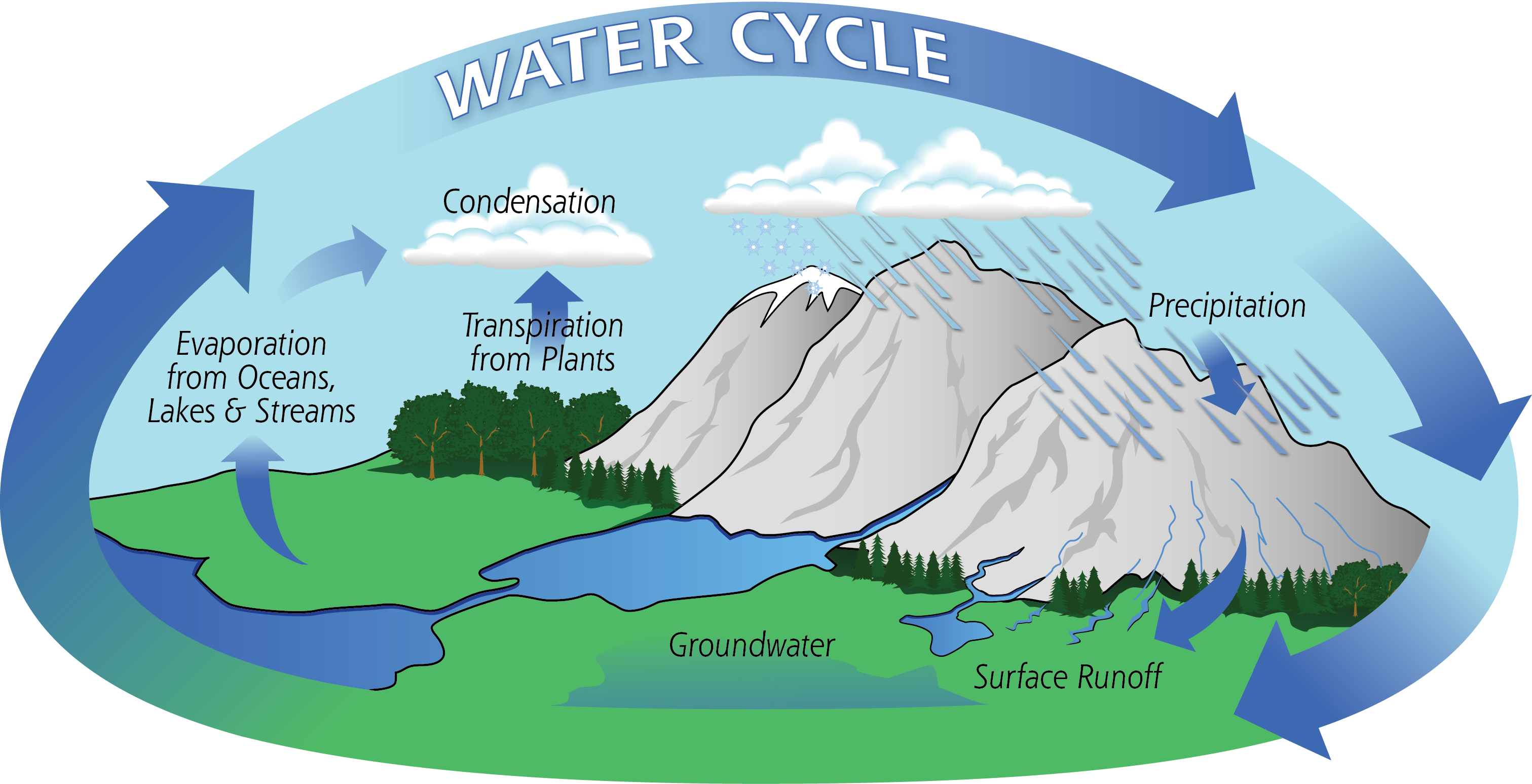
This image is under the creative commons license Attribution-NonCommercial-NoDerivatives 4.0 International (CC BY-NC-ND 4.0). You can share this picture however, you need to give credit to the author and you cannot modify it and you cannot use the material for commercial purposes. This image helps us understand the water cycle and all the different processes in a graphic and visual way as some people learn better by looking at images or diagrams. It is a good reference because it mentions each process and shows a visual description to make sure the audience understands the basic concept of each process.


Comments
Post a Comment